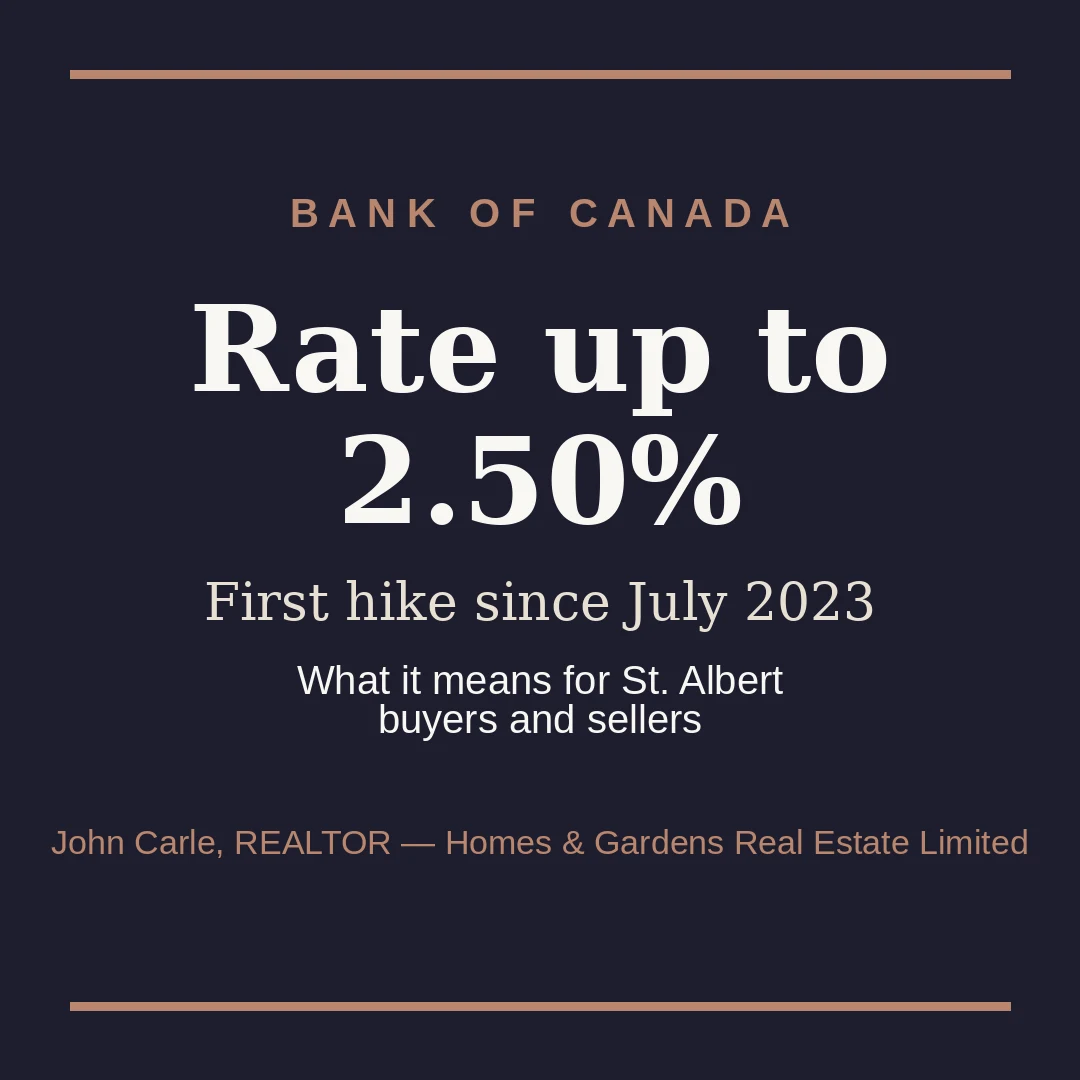
The Bank of Canada raised its policy rate this morning by a quarter point, to 2.50%. It is the first increase since July 2023, and it ends a run of seven straight holds at 2.25%.
This was not a move against a hot housing market. September inflation came in at 3.1%, and almost all of that increase was energy — fuel prices working their way through transportation and production costs. Core inflation, the part the Bank watches most closely, is still sitting near 2%. The Bank is worried those energy costs get passed along to consumers over the next year, so it moved early. It expects inflation around 3.5% by the end of this year, about 3% through 2027, and back to the 2% target around mid-2028. It also said, plainly, that housing is expected to stay relatively weak.
There is an Alberta angle to this, and it matters more than the hike itself. The same high energy prices that pushed inflation up and forced the Bank's hand are the prices that drive this province's economy. A quarter point on borrowing costs is a suppressant, but a small one. Oil at $100 would drive Alberta jobs, incomes, and housing demand in a major way — a far bigger force for this province than a 0.25% rate increase will ever be in the other direction. If energy prices stay high, the tailwind for Alberta is bigger than the headwind from the Bank of Canada.
What does a quarter point mean in real terms?
If you have a variable-rate mortgage, your rate is tied to your lender's prime rate. Prime has been 4.45% and is expected to move to 4.70% as the banks make their announcements over the next day or so. On a $500,000 variable mortgage, a quarter point works out to roughly $66 more a month. Real money, but not a crisis for most households — and if your payments are fixed, more of each payment goes to interest instead, which slows down how fast you build equity.
If you have a fixed-rate mortgage, nothing changes until renewal. Fixed rates follow bond markets, not the Bank's policy rate directly.
If you are buying, your purchasing power on a variable rate edges down slightly, and the stress test moves with it. If you are selling, the honest read is that this hike was aimed at energy-driven inflation, not at cooling demand that is not there. The Bank itself expects housing to stay quiet, and it has signalled it will move carefully from here. The next decision is December 9.
One more hike or two would start to matter. One, on its own, mostly does not change the math on a good decision. If you were about to buy the right house or sell at the right time, a quarter point should not be the thing that stops you — and if a deal only worked at 2.25%, it probably was not the right deal.
Questions about your own mortgage — whether to fix, float, or refinance — belong with a mortgage professional, and I am happy to point you to a good one. Questions about what this means for buying or selling in St. Albert, that is my job.
John Carle, REALTOR Homes & Gardens Real Estate Limited Just Call John. 780-937-7534