The Quick Answer
The City of St. Albert doesn't require every homeowner to obtain a compliance certificate, but a buyer's lender or purchase contract often will. The City says standard processing can take up to 15 working days and recommends applying when the property is listed, not after an offer is pending.
— John Carle, St. Albert REALTOR®
The shed was added eight years ago. The deck grew by six feet. A fence moved when the neighbour rebuilt it.
None of that feels urgent until a buyer's lawyer asks for a current Real Property Report and municipal compliance before possession.
Then the sale has dates attached.
A seller can avoid most of that pressure by finding the RPR early, checking whether it still reflects the property and sending the right document to the City before negotiations begin.
On this page
Key Takeaways at a Glance
- A Real Property Report, or RPR, is a legal document prepared by an Alberta Land Surveyor.
- It shows property boundaries and visible improvements such as the house, garage, deck, shed and fences.
- St. Albert's compliance certificate explains how the improvements shown on the RPR relate to the Land Use Bylaw.
- The City's standard process can take up to 15 working days; accelerated service is listed at five business days for eligible sites.
- St. Albert's application checklist asks for RPRs produced no more than five years before submission.
- An RPR doesn't technically expire, but it becomes outdated when visible improvements change.
"John Carle says:" — Paperwork is cheaper before pressure
"Don't wait for a firm possession date to discover the deck isn't on the RPR or the shed sits in a setback. Find the survey when you decide to sell. If it needs an update, a permit or an encroachment discussion, time gives you options. A deadline takes them away."
— John Carle, St. Albert REALTOR® with 25+ years in the market
What an RPR shows
The Alberta Land Surveyors' Association defines an RPR as a legal document prepared by an Alberta Land Surveyor. It shows property boundaries and the position of visible improvements relative to those boundaries.
A typical RPR includes:
- the legal description and municipal address
- the title number and registered owner
- the location and dimensions of visible improvements
- structures that cross onto a neighbouring parcel or public land
- easements and rights-of-way registered on title
It isn't a home inspection. It won't tell a buyer whether the roof leaks or the furnace works.
It also isn't a title search. It draws relevant boundaries and improvements, while the current title identifies registered interests. Lawyers and surveyors handle different parts of the file.
The City's RPR page gives the simplest local description: it is a property owner's best way to understand boundaries and the type and location of improvements.
What the compliance certificate adds
The RPR is prepared by a surveyor. Compliance is reviewed by the municipality.
According to the City of St. Albert compliance page, a compliance certificate is a letter or stamped RPR advising whether the use complies with zoning and how the developments shown relate to Land Use Bylaw regulations.
That review depends on the RPR being accurate and complete. The City says it can't comment on buildings, improvements or measurements that are wrong or missing from the submitted document.
This is why an old RPR can create false comfort. The drawing may be perfectly accurate for the day it was prepared and still fail to show a later deck, air-conditioning unit, shed, gazebo, fence or garage alteration.
St. Albert doesn't require one, but your deal might
The City doesn't impose a blanket requirement that every owner obtain a compliance certificate.
Real-estate contracts and lenders operate separately. The City notes that financial institutions commonly require compliance before releasing mortgage funds, or a purchase offer may make it a condition.
So "the City doesn't require it" isn't the same as "the seller won't need it."
The contract controls the seller's delivery obligation. The buyer's lender and lawyer may have their own requirements. Sellers should review those obligations with their lawyer rather than assuming title insurance will solve everything.
Is an older RPR still usable?
ALSA says an RPR doesn't technically expire. It becomes outdated if improvements have been added or changed.
St. Albert's current compliance application checklist is more specific: it asks for at least two original RPRs produced no more than five years before submission. Email applications require original stamped and signed copies in PDF, and poor or incomplete scans aren't accepted.
That means a survey can remain historically valid but still be unsuitable for the City's current application process.
Check three things:
- Does the drawing match what is physically on the lot today?
- Does it meet the City's current submission requirements?
- Is it legible, signed and stamped as required?
If the original surveyor is known, ALSA notes that the surveyor may be able to update the RPR. There is no central database holding every RPR in Alberta, so don't assume the City or another office can retrieve it.
What commonly makes an RPR stale
Walk the outside of the property with the drawing in hand.
Look for changes to:
- decks, steps and landings
- detached garages and sheds
- fences and retaining walls
- air-conditioning equipment
- hot tubs, gazebos and permanent structures
- additions or enclosed porches
- driveway widening
Not every small item is treated the same way under every rule. The point isn't to diagnose compliance yourself. The point is to identify anything that doesn't match before submitting the document.
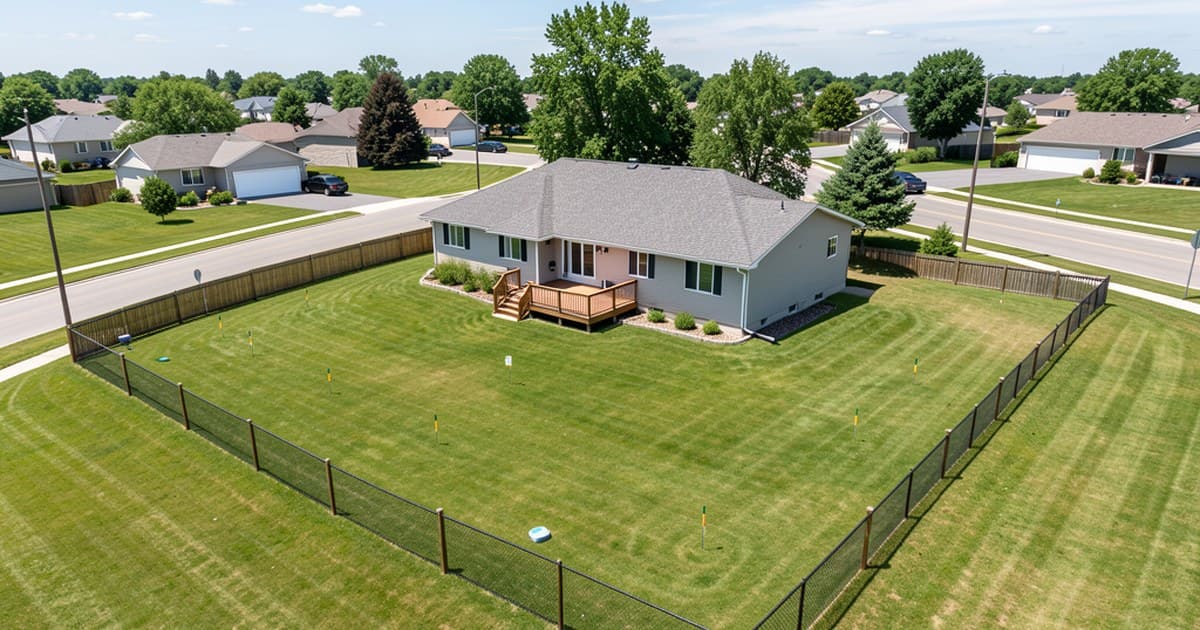
A fence shown in a different location deserves attention. So does a shed close to a rear or side boundary. If a structure appears to cross onto City land, a utility right-of-way or a neighbouring lot, stop guessing and get qualified advice.
What happens if something doesn't comply?
A non-compliance result doesn't automatically mean the sale dies. It means the issue has to be understood.
Possible paths can include:
- correcting an error on the RPR
- obtaining a missing development permit
- moving or altering an improvement
- applying for a variance where available
- dealing with an encroachment
- negotiating a contractual solution with legal advice
The correct path depends on what is wrong and where it sits. A fence that is a few centimetres off the drawing isn't the same problem as a garage crossing a property line.
Don't promise a buyer that the City will approve a variance. Don't move a structure on the strength of a neighbour's opinion. And don't describe title insurance as guaranteed permission to leave a land-use problem in place.
The seller's lawyer, an Alberta Land Surveyor and the City's Development Branch each have a role.
The timing sellers should use
St. Albert says standard processing can take up to 15 working days. Accelerated service can take five business days, but it isn't available for commercial, industrial or residential multi-family sites.
Fifteen working days is roughly three calendar weeks before allowing for holidays or an incomplete application.
The City explicitly recommends applying when the property is listed rather than waiting for an offer. That's sensible. An offer may allow only a few days for conditions, and possession may be four to eight weeks away.
A practical seller timeline looks like this:
Before listing
Find the RPR. Compare it with the property. Ask the original surveyor whether an update is possible if changes have been made.
At listing
Submit a complete compliance application if the property and document are ready. Keep proof of submission and give the lawyer a copy of what was sent.
During an offer
Read the RPR and compliance clause. Confirm exactly what must be delivered and by what date. If anything is unresolved, disclose the status accurately and let the lawyers draft the solution.
Before possession
Deliver the required documents through the lawyer. Don't leave municipal correspondence in an email inbox and assume everyone has it.
For the broader preparation sequence, read John's St. Albert seller guide.
RPR versus title insurance
Sellers sometimes hear that title insurance can replace an RPR. That statement is too broad.
Title insurance is an insurance contract. Coverage depends on the policy, exclusions, the known facts and the insurer's underwriting. It doesn't redraw boundaries, issue municipal approval or make an unlawful improvement compliant.
A buyer's lender may accept a title-insurance solution in a particular transaction. The purchase contract may still require an RPR with evidence of compliance unless the parties amend it.
This isn't a choice to make from a blog post. The buyer and seller should each ask their own lawyer what the contract requires and what a proposed insurance policy would and wouldn't cover.
If you're buying, read the document too
An RPR isn't only a seller chore.
A buyer should compare the drawing with the yard during the inspection period. Is the shed shown? Does the fence appear to follow the boundary? Is the deck the same shape? Is there an easement where the buyer wants to build another garage?
Compliance confirms the City's review of what is shown. It doesn't promise that every future plan will be approved.
If you intend to add a structure, ask the City about current Land Use Bylaw requirements before relying on what a previous owner was permitted to build.
A seller's RPR checklist
- Locate the newest signed and stamped RPR.
- Compare every visible improvement with the drawing.
- Note anything added, moved, enlarged or removed.
- Contact an Alberta Land Surveyor if an update is needed.
- Review St. Albert's current application checklist and fees.
- Submit early enough for standard processing.
- Send the RPR, application and City response to the lawyer.
- Don't make legal promises about compliance, encroachments or insurance without advice.
This is boring paperwork right up until it isn't. Handle it while the calendar is still yours.
Sources
- City of St. Albert: Compliance Certificates, processing times, application requirements and local compliance explanation, last edited March 11, 2026.
- City of St. Albert: Real Property Reports, local definition and surveyor requirement, last edited March 11, 2026.
- Alberta Land Surveyors' Association: Real Property Reports, contents, currency and surveyor guidance, accessed July 21, 2026.
Bottom Line
St. Albert doesn't order every seller to obtain a compliance certificate, but the transaction often does. The City can take up to 15 working days and asks for an RPR produced within five years for its current application process.
Find the document early. If the yard no longer matches the drawing, deal with it before a buyer's deadline turns a manageable survey issue into a closing problem.
For a straight review of the selling steps and who needs to handle what:
Just Call John.